
How Tile Drainage Drastically Transforms Field Performance

Water is one of the biggest variables in every growing season. There is either too much of it or not enough, and rarely does it arrive at the right time. Poorly drained soils mean delayed planting, shallow roots, more compaction, reduced nutrient availability and ultimately lower yields. Subsurface drainage can change that.
Today’s tile installation is a precise, data-driven process that puts modern guidance tools and GNSS technology to work below the surface of your fields. With just a handful of components, farmers can take direct control of their water table and create consistent, high performing fields year after year.
How Subsurface Drainage Works
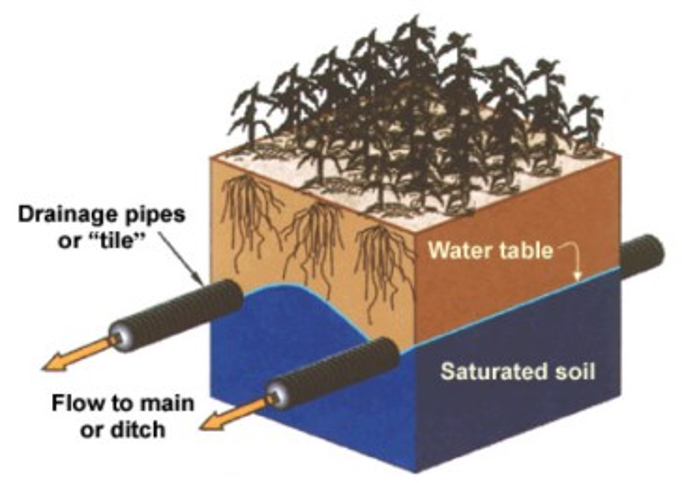
Drain tile lowers the water table by giving excess water a controlled exit path. Tile lines collect water from the soil profile and move it toward an outlet at the lowest edge of the field. As the water table drops, roots grow deeper, soils warm quicker and equipment can enter fields sooner.
The benefits are both immediate and long lasting. For many growers, tile is one of the few investments that pays off within about 5 years while continuing to deliver value for decades.
A Real Field Example
One of the clearest examples of the impact tile can have comes from the Shoup Bros. family farm operation in northeast Ohio. Their SV26 field is 26 acres of poorly drained clay that often held water well into the planting window. In 2020, the field was so wet that only 17.4 acres were planted to corn. In the following years, soybeans continually replaced corn simply because soil conditions never allowed for timely corn planting.
The 2020 corn yield averaged 145 Bu/ac across those limited acres. Several years of poor conditions led to a decision in the 2024-25 winter to work with a local contractor to install a complete pattern tile system with 4-inch laterals tying into a 6-inch main.

Even with an unusually wet 2025 spring, 24.8 acres were planted with corn, an increase of 7.4 acres compared to 2020. The average corn yield rose to 231 Bu/A, a gain of 86 Bu/A.
Total production increased from 2,523 bushels in 2020 to 5,729 bushels in 2025, more than doubling output in the first season. At a harvest price of $4.22 per bushel that season, SV26 generated $13,529.32 more revenue in its first year with tile.

Why Tile Improves Yields
This type of gain is not unusual. Many studies from universities, seed companies and independent testing show consistent yield improvements in both corn and soybeans when drainage is added.
1. Better Field Access
When fields dry earlier, planting can happen on time. Gaining even a single extra day can improve corn emergence, root development and overall yield potential. In wet springs, this benefit alone can determine the success of the entire season.
2. Stronger, Healthier Root Systems
Roots grow toward the water table. With drainage lowering that level, roots stretch deeper into the soil profile. This increases access to moisture during dry periods and supports stronger, more resilient plants.
3. Reduced Compaction
Wet soils compact easily, squeezing pore spaces that normally hold water, air and allow roots room to breathe and grow. Compacted soils slow water movement and root growth. Tile drainage creates firmer, more trafficable soils that resist compaction and maintain healthy structure.
4. Year Over Year Consistency
When every acre is plantable and growing conditions are uniform, it becomes easier to plan, manage and harvest efficiently. Tile turns a field from unpredictable to reliable.